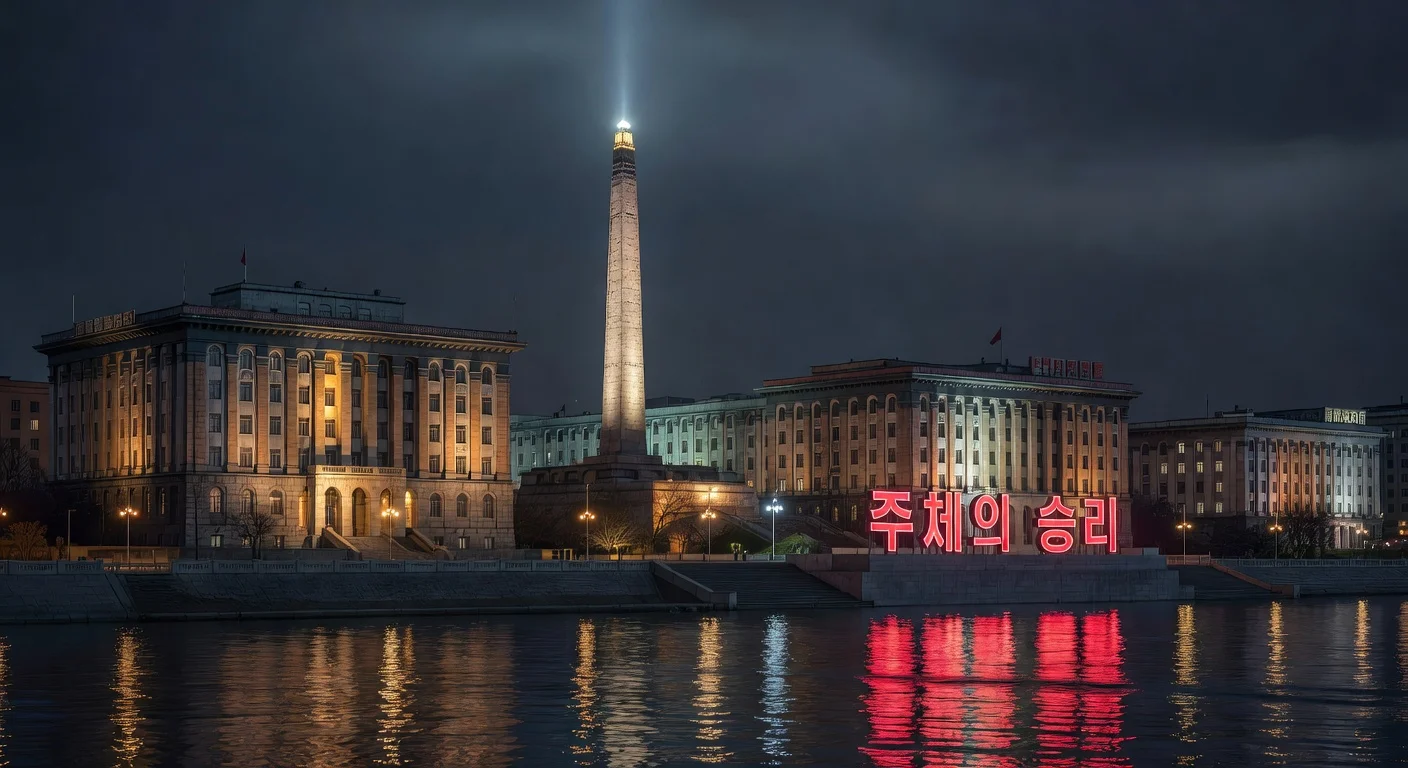
Why There’s No McDonald’s in North Korea (2026)
I keep a spreadsheet of countries where the Big Mac Index has no data, sorted by whether the gap is recoverable. Russia has shadow data through Vkusno i tochka. Iran has a knock-off chain and a black-market exchange rate. Iceland has Metro burger receipts on Reddit. North Korea has nothing — and not in the same way as the others. Russia had and lost. Iran had briefly. North Korea has never been on the map, and as of May 2026 there is still no Big Mac sold inside the DPRK, no licensee, no successor brand, no reasonable proxy.
This piece is my notes on why. It’s the sixth in a series of out-of-market writeups after Russia, Iran, Iceland, Cuba and Bolivia, and it’s the cleanest case of “never opened” in the dataset.
The short answer
McDonald’s has never operated a restaurant in the Democratic People’s Republic of Korea. The country has been hostile to American consumer brands since its founding in 1948, isolated from US trade since the Korean War armistice in 1953, and under successive layers of US, UN and bilateral sanctions since 2006. The ideological framework — Juche, the doctrine of national self-reliance that has been state ideology since the 1960s — treats Western branded consumer culture as a contamination to be excluded by design, not just by accident. There has never been a McDonald’s in Pyongyang, never one in Kaesong’s industrial complex during its 2004–2016 inter-Korean experiment, and no credible plan for one even during the brief Trump-Kim diplomatic thaw of 2018–2019.
The Juche framework
You can’t tell the McDonald’s story without Juche. Translated loosely as “self-reliance,” Juche has been DPRK state ideology since Kim Il-sung formalised it in the 1960s. Its three core principles are jaju (political independence), jarip (economic independence) and jawi (military self-defence) (Britannica: Juche; Wikipedia: Juche).
What that means in retail terms is that any Western brand operating inside North Korea would be an explicit policy reversal. The DPRK doesn’t just ban McDonald’s the way Iran does (through political climate plus US secondary sanctions) or the way Cuba does (through US embargo plus an absent franchise environment). It treats the category — foreign-headquartered consumer brands that bring imagery, supply chains and an implicit cultural payload — as ideologically off-limits.
This is the distinction worth holding onto: in Russia, McDonald’s was invited in 1990 and expelled in 2022. In Iran, McDonald’s existed briefly in the 1970s and was kept out afterwards. In North Korea, the entry has never been on the table. There is no analogue to the 1990 Pushkin Square opening, no analogue to a 1994 Tehran storefront. The chain has been excluded since 1948 by the structure of the state.
1948–1990: war, blockade, socialist bloc
The DPRK was founded in September 1948 under Soviet patronage. By 1950 it was at war with US-backed South Korea. The armistice of 1953 froze the conflict without a peace treaty, leaving the United States in a formal state of unfinished war with North Korea — a status that still holds in 2026. The first US sanctions on the DPRK pre-date almost every other modern sanctions regime, going back to the Trading with the Enemy Act in 1950.
Through the Cold War, North Korea’s economic partners were the Soviet Union, China and the socialist bloc. Western consumer brands of any kind — not just McDonald’s, which didn’t yet exist abroad in any meaningful way — were structurally absent. The DPRK built its own industrial base around heavy industry, military production and command-economy retail. Pyongyang department stores stocked goods from East Germany, Romania and the USSR rather than from any capitalist supply chain.
McDonald’s, for context, only opened its first international store (Richmond, British Columbia, Canada) on June 1, 1967, followed by Costa Rica in 1970 and its first store in the Soviet Union (Moscow) in 1990. Through the 1980s, the DPRK was both materially poorer than the USSR and ideologically more hostile to opening up. There was no plausible mechanism by which a McDonald’s could have entered.
The 1990s: Arduous March
The collapse of the Soviet Union in 1991 was a catastrophe for the DPRK. Soviet oil, fertiliser, machinery and food aid disappeared almost overnight. Energy imports fell by roughly 75 percent and agriculture, which had been heavily mechanised and fertiliser-dependent, collapsed in parallel (Wikipedia: 1990s North Korean famine; Association for Asian Studies).
The resulting famine — officially renamed the Arduous March by state propaganda in 1993 — ran from roughly 1994 to 1999 and killed between 240,000 and (in higher-end academic estimates) 3.5 million people out of a population of around 22 million. Words like “famine” and “hunger” were banned in state media because they implied government failure.
This is the period in which McDonald’s was aggressively expanding into post-Soviet markets. The chain opened in Moscow (1990), Warsaw (1992), Beijing (1992), and Riyadh (1993). The DPRK did the opposite — it tightened ideologically, restricted external contact, and survived on Chinese trade and trickled humanitarian aid. Whatever theoretical openness to Western brands might have existed under Kim Il-sung in the 1980s evaporated under Kim Jong-il in the 1990s.
2000s: limited openings, no Big Mac
The 2000s saw two narrow openings worth noting, neither of which produced a McDonald’s.
Kaesong Industrial Complex (2004–2016). The most concrete inter-Korean economic experiment opened in December 2004 just north of the DMZ. At peak operation, 125 South Korean firms employed roughly 55,000 North Korean workers producing textiles, kitchen utensils, auto parts and other manufactured goods. Over the period 2004–2016, North Korea earned about $550 million in wages and South Korean firms grossed about $3.2 billion (Wikipedia: Kaesong Industrial Region; 38 North, September 2024).
There was a Family Mart convenience store inside the complex (rebranded CU later) but no Western fast food. The Kaesong zone was a manufacturing arrangement, not a consumer one — North Korean workers did not get McDonald’s, and South Korean managers did not bring branded restaurants across the border. The complex was closed by Seoul in February 2016 after a DPRK nuclear test, and has not reopened.
The Pyongyang elite and Western food. The other 2000s opening was tightly controlled and pointed inward: bringing limited Western cuisine to Pyongyang’s senior leadership rather than letting brand presence expand outward.
Daedonggang and the Furlanis pizza story
The most-told story of Western food in Pyongyang is about pizza, not burgers. In spring 1997, Italian pizzaiolo Ermanno Furlanis was flown to Pyongyang along with another Italian chef to train North Korean military personnel — reportedly generals and officers — in pizza-making. They spent three weeks instructing meticulous but creatively constrained pupils, with one officer asking Furlanis for the exact permitted distance between olives on a pizza. Furlanis later published a long three-part account in Asia Times Online in 2001 (Wikipedia: Pizza in North Korea; Pizza Marketplace).
Kim Jong-il had reportedly wanted a pizzeria for over a decade. The Pizza Restaurant on Kwangbok Street finally opened in December 2008, with flour, butter and cheese flown in from Italy. By 2010, its menu offered eleven traditional pizzas and other Italian dishes alongside Korean food, with prices of roughly $5 to $10 USD per pizza — potentially more than a month’s salary for a middle-ranking official, and accessible only to elites, diplomats and foreign visitors (Taipei Times, March 2009; Korea Times, 2020).
This is the closest analogue to a McDonald’s that has ever existed in Pyongyang, and it tells you why a real McDonald’s hasn’t followed. The pizzeria was state-controlled, ingredient-imported, elite-priced and ideologically curated as a novelty rather than a brand. There is no franchise relationship, no royalty payment, no logo licensing, no marketing. The DPRK can tolerate that. It cannot tolerate — and the US sanctions regime cannot legally permit — a Golden Arches operation with American corporate ownership.
Samtaesong: the local burger chain
Pyongyang also has a hamburger chain, just not a Western one. Samtaesong (“Three Huge Stars” — referring to Kim Il-sung, Kim Jong-suk and Kim Jong-il) opened its first Pyongyang outlet in May 2009, founded by Singaporean investors Patrick Soh, Quek Cher Lan and Timothy Tan (Wikipedia: Samtaesong; Radio Free Asia, October 2010).
Burgers don’t appear on Samtaesong’s menu under that name — they’re called “minced beef and bread.” Radio Free Asia reported the chain was effectively owned by Kim Kyong-hui, Kim Jong-il’s sister. By 2018 there were around 30 outlets. A burger at official exchange rates ran around 228 North Korean won, more than half a daily wage, restricting it to people with foreign currency or elevated rank (Mothership.SG, June 2018).
Samtaesong is not a McDonald’s analogue in the way that Vkusno i tochka is in Russia. It wasn’t a successor — there was nothing to succeed. It’s a small, state-aligned chain serving Pyongyang’s foreign-currency holders, with a Singaporean founding team rather than a Western one. Its existence shows that the DPRK can host hamburgers; it does not show any path toward letting in the American chain that defines the global burger reference price.
Defectors, Dandong and the China-border encounter
For ordinary North Koreans, the way you encounter McDonald’s is by leaving. The most-quoted defector accounts of trying Western food describe it happening either in northeastern China, in South Korea after resettlement, or — for the upper-bracket defectors — in Southeast Asia during family trips abroad.
Dandong, the Chinese city across the Yalu River from Sinuiju, is the busiest land crossing on the DPRK border. It hosts McDonald’s, KFC and a wide range of Chinese fast-food chains within walking distance of the river. Defectors who pass through or work briefly in the Dandong area before moving deeper into China describe Western fast food as one of the first concrete signs of how different the outside is — but I have not found a single named, on-the-record testimony specifically about a defector’s first McDonald’s meal at the Dandong location, and I’m not going to invent one (Washington Post, June 2018; general defector context: Wikipedia: North Korean defectors).
The Pyongyang elite encounter Western fast food differently. Kim Jong-un himself attended school in Switzerland — most likely the German-language Schule Liebefeld Steinhölzli in Köniz from roughly 1998 to 2000, after earlier time at the private International School of Berne (Study International; LeNews, March 2024). Reporting on his Swiss years describes a teenager attached to American basketball, Hollywood films and McDonald’s. The image of a North Korean ruler personally familiar with the product but refusing to allow it inside his own country is one of the more striking parts of this story.
2018: the Trump-Kim warming era
The closest McDonald’s has ever come to entering North Korea was a rumour during the 2018 Trump-Kim diplomatic thaw.
In late April 2018, South Korean presidential adviser Chung-in Moon publicly said that North Korea might be interested in welcoming a McDonald’s as part of broader normalisation. Around the same time, NBC News reported on a US intelligence assessment that Kim Jong-un was considering allowing a “Western hamburger franchise” in Pyongyang as a goodwill gesture, partly to cater future bilateral meetings (Washington Post, June 2018; South China Morning Post, June 2018).
It never happened. The Singapore summit in June 2018 produced a vague joint statement but no concrete denuclearisation deal. The Hanoi summit in February 2019 collapsed without agreement. No sanctions relief followed, US secondary sanctions remained in place, and McDonald’s did not enter. The Cato Institute argued at the time that even if a store opened, it would not transform anything structural about the regime (Cato Institute) — but the question is moot, because the store never opened.
In 2026, with US-DPRK relations frozen and North Korea even more closed than during the COVID-era 2020–2023 shutdown, the 2018 rumour is the closest the franchise has ever come, and it was never closer than a press leak.
How this compares to Russia, Iran and Cuba
The Track C sub-cluster of “no McDonald’s because of sanctions and/or hostile politics” is worth comparing as a group:
- Russia. Opened 1990, grew to 850+ restaurants, exited 2022, replaced by Vkusno i tochka. Shadow PPP data is available through the successor brand. (Russia writeup)
- Iran. No evidence of any franchise, ever; an attempted 1994 opening was destroyed within days, and US sanctions have kept it out since. Knock-off chains like Mash Donald’s provide weak proxy data. (Iran writeup)
- Cuba. Never officially on the island; one in-base McDonald’s at the Guantanamo Bay US naval station. Embargo plus political environment. (Cuba writeup)
- North Korea. Never operated, no successor brand, no proxy, no published menu prices, no exchange rate that means what it says.
North Korea is the most extreme case. It’s the only one where there is no story of an opening, no story of a closure, and no shadow product. Samtaesong exists but is too small, too elite-restricted and too politically opaque to function as a Big Mac substitute the way Vkusno i tochka does. The Pyongyang pizzeria served Italian food, not American, and only to a tiny customer base.
What this means for the Big Mac Index
For bigmacindex.app, North Korea is a permanent grey cell on the map. There’s no January 2026 number, no July 2026 number planned, no chance of one in any future iteration of The Economist’s CSV under current conditions.
What makes the DPRK case methodologically interesting is that every PPP shortcut fails:
- No direct Big Mac price. No McDonald’s exists.
- No franchise successor. No Vkusno i tochka equivalent. Samtaesong is too small and too far from the McDonald’s product profile.
- No usable exchange rate. The official rate (roughly 900 KPW per USD) is essentially fictional. Black-market rates in Pyongyang have been quoted at 8,000 to over 13,000 KPW per USD in the past decade, and even those are inconsistent.
- No reliable price data. South Korea’s central bank (Bank of Korea) produces an annual DPRK GDP estimate — roughly $26 billion total in recent years on a population of about 26 million, implying GDP per capita near $1,000 — but this is reconstructed from external proxies, not from any published DPRK statistical series. Internal price data is treated as a state secret (Conversable Economist, April 2026).
This is different from Iran’s case, where I can at least build a “shadow Big Mac” from Mash Donald’s prices and the unofficial rial market rate, with a clear caveat. For North Korea I can’t even do that honestly. The DPRK belongs in the PPP failure cases bucket as the cleanest example: a closed economy where the basic preconditions of PPP measurement — a comparable consumer product, a meaningful exchange rate, and observable retail prices — are all absent simultaneously.
I plan to keep DPRK in the country listing on the main index as a permanently greyed entry with a link to this writeup. That’s more honest than pretending there’s a number.
FAQ
Has any Pyongyang elite actually eaten a Big Mac? Almost certainly yes, but outside North Korea. Senior DPRK officials transit through Beijing, Shenyang, Singapore and Macau. Kim Jong-un attended school in Switzerland from roughly 1998 to 2000 and has been described by classmates as a regular consumer of Western fast food during those years. The product enters the country only through the bodies of officials who travelled to eat it elsewhere.
Did the Kaesong Industrial Complex have any Western fast food? No. Kaesong (2004–2016) was a manufacturing zone with restricted access. A Family Mart convenience store operated inside the complex, but no Western fast food chains were ever established there. The arrangement was designed to bring South Korean managers and DPRK labour together for industrial production, not to host consumer brands.
Where is the nearest McDonald’s to North Korea? The closest McDonald’s outlets to the DPRK are in Dandong, China — directly across the Yalu River from Sinuiju — and in Seoul, just over an hour’s drive south of the DMZ on the South Korean side. Both are physically very close but politically inaccessible from inside North Korea.
Why didn’t McDonald’s open during the 2018 Trump-Kim talks? Because the underlying deal never closed. The Singapore and Hanoi summits did not produce sanctions relief, the OFAC framework restricting US firms from doing business with the DPRK stayed in place, and McDonald’s itself never made a public commitment. The whole episode lived as a press leak and a piece of diplomatic atmospherics, not a corporate plan.
If Korea reunifies, will the DPRK side get McDonald’s? Probably, eventually. The South Korean market alone has over 400 McDonald’s outlets and the chain expanded aggressively in the post-1988 democratisation period. A reunified Korea — whatever path it takes — would likely see McDonald’s enter the northern half within a few years through the existing South Korean operating arm. But this is downstream of a political event that has not happened and is not visible on any current timeline.
Sources used in this article
- Britannica: Juche
- Wikipedia: Juche
- Wikipedia: 1990s North Korean famine
- Association for Asian Studies: North Korea’s 1990s Famine in Historical Perspective
- Wikipedia: Kaesong Industrial Region
- 38 North: Kaesong Industrial Complex — A Tortured History and Uncertain Future (September 2024)
- Wikipedia: Pizza in North Korea
- Taipei Times: North Korea gets its first pizzeria (March 2009)
- Pizza Marketplace: Trip to North Korea shows pizza maker a shocking slice of communist life
- Wikipedia: Samtaesong
- Radio Free Asia: Happy Meals in Pyongyang? (October 2010)
- Washington Post: North Korea reportedly wants a McDonald’s (June 2018)
- Conversable Economist: North Korea’s Economy — How to Study a Data Black Hole (April 2026)
For the broader index methodology and the limits of PPP measurement in closed economies, see the 2026 breakdown, the methodology page and why PPP fails.
Want to see where McDonald’s is? Big Mac Index data → · Methodology → · Spot a mistake? Email me at support@bigmacindex.app.