Why There’s No McDonald’s in Bhutan (2026)
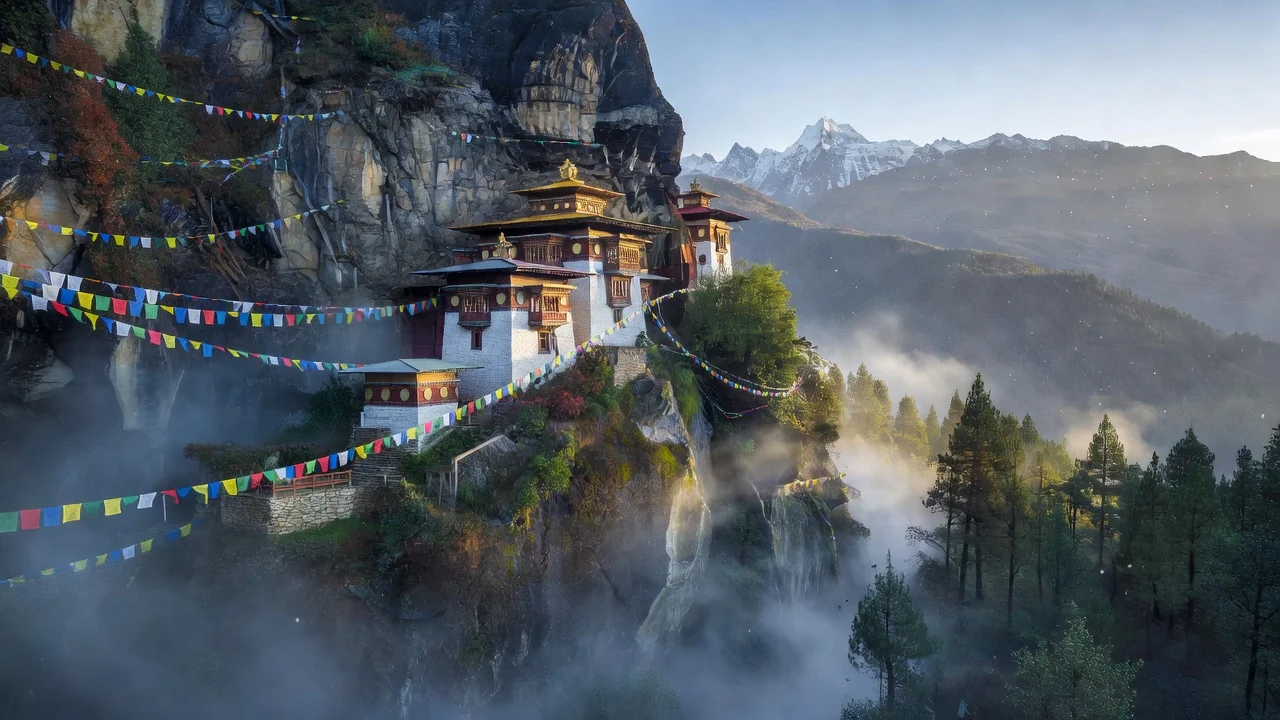
The first time I sat down to map this one I tried to fit Bhutan into the same bucket as North Korea — “never opened” — and it didn’t work. The fact pattern looks similar from very far away: no McDonald’s in 2026, no franchise history, no successor brand, no shadow price you can pull off a receipt. But the context is almost the inverse of the DPRK case. Bhutan isn’t closed because it is afraid of the outside or hostile to American capital. It is a small, landlocked market whose state has spent fifty years putting Gross National Happiness ahead of GDP and keeping tourist numbers low. Nobody, in the government or at McDonald’s, has said on the record that this is why there is no McDonald’s; it is the reading the evidence allows.
This is the eighth entry in the “no McDonald’s” series after Russia, Iran, Iceland, Cuba, Bolivia, North Korea, and Yemen. Bhutan is the case in the dataset that most invites a cultural protection reading, though it is a reading, not a stated policy.
The short answer
McDonald’s has never operated a restaurant in the Kingdom of Bhutan. KFC, Burger King, Subway, Pizza Hut and Starbucks have not opened either. The absence isn’t enforced by a single statute named “no McDonald’s.” It falls out of a stack of overlapping choices: the Gross National Happiness (GNH) framework that has been state ideology since the 1970s and constitutional law since 2008, the Sustainable Development Fee (SDF) that gates tourism at roughly $100 per night in 2026 for dollar-paying visitors (Indian tourists, 73% of arrivals in 2019, pay about $15), foreign-investment rules that require government approval and cap foreign ownership at 74% for most activities (FDI Policy 2019), and a local food economy where the national dish (ema datshi — chilies cooked as a vegetable in cheese sauce) sells for the rough equivalent of a few US dollars and is what almost everyone actually eats. There is no record that McDonald’s ever applied, or that Bhutan ever turned it down, and the regulatory geometry would make a single store difficult and a national rollout effectively impossible. The rules do not shut out foreign brands as such: franchise deals are allowed with ministry permission, and several international retail franchises, Miniso among them, trade in Thimphu (BBS, September 2023).
The Gross National Happiness framework
You can’t tell the McDonald’s story in Bhutan without GNH, in the same way you can’t tell the DPRK story without Juche. The two ideologies could not be more different in spirit, but they both make Western consumer brands structurally awkward.
GNH was articulated by King Jigme Singye Wangchuck in the early 1970s as an alternative to GDP-led development. Over the following decades it was operationalised by the Centre for Bhutan Studies into a measurable index. The current version has four pillars — good governance, sustainable and equitable socio-economic development, preservation and promotion of culture, and environmental conservation — broken into nine domains (CBS: Gross National Happiness; Wikipedia: Gross National Happiness). The nine domains are: psychological wellbeing, health, time use, education, cultural diversity and resilience, good governance, community vitality, ecological diversity and resilience, and living standards. Underneath those sit 33 indicators and over 150 variables that get measured in a periodic national survey.
The one that does the heavy lifting for our question is cultural diversity and resilience. The domain is defined, in CBS material, as the culture’s capacity to maintain and develop its own identity, knowledge, and practices in the face of competing norms. That’s the policy hook. A Golden Arches storefront in Thimphu is not banned by any statute I can find. On my reading it would score badly on the cultural-resilience indicator and on the time-use one (drive-through eating versus shared meals), and as a franchise it would need the prior written permission of the ministry under an investment policy that opens by naming GNH as the country’s guiding concept (FDI Policy 2019).
When GNH was enshrined in Article 9 of the 2008 Constitution as a duty of the state, it stopped being a slogan and became something a Bhutanese regulator has to weigh (Bhutanese democracy — Wikipedia; Britannica: Bhutan, From absolute monarchy to parliamentary democracy). Whether that lever has ever been pulled against a restaurant chain is not on record: I found no government statement on McDonald’s and no sign McDonald’s ever applied.
The Sustainable Development Fee
The second structural reason is on the demand side. Bhutan does not have a backpacker tourism economy, and never has.
From 1974 until 2022, the country ran a “Minimum Daily Package Rate” of around $200 per visitor per day, all-inclusive, with an embedded royalty going to the state. After COVID, the policy was rebuilt. From June 2022 the package rate was abolished and replaced by a Sustainable Development Fee (SDF) of $200 per person per night charged on top of independently booked accommodation, food and transport (Bhutan Travel: Sustainable Development Fee; TravelAge West, 2023). When arrivals didn’t recover at that level, the SDF was halved to $100 per person per night from 1 September 2023 as a temporary discount, valid until 31 August 2027 (Department of Tourism press release, August 2023; CNBC, May 2024). That is the rate for dollar-paying visitors. Indian travellers, who made up 73% of arrivals in 2019, pay a reduced 1,200 ngultrum (about $14.50) per night, according to the same CNBC report.
The headline framing is environmental — the fee funds conservation, free healthcare, free education, and infrastructure. The structural effect is that mass-market tourism doesn’t exist in Bhutan. A family of four traveling for a week pays roughly $2,800 in SDF alone before any hotel or meal. There is no equivalent of the cheap, high-volume backpacker flow that supports a McDonald’s in Phnom Penh, Kathmandu or Hanoi.
For a fast-food unit-economics model, this matters. A McDonald’s store profile assumes you can stack low-margin transactions in volume — locals on lunch breaks, families on weekends, tourists on a budget. Bhutan’s tourism policy explicitly suppresses the third group, and the local population is small (~780,000) and dispersed. The math doesn’t close. This is the closest analogue to the Iceland case (Iceland writeup →) — high import-cost, small market — but layered with a deliberate state choice to keep visitor volumes low rather than an FX shock.
The absence of Western chains, plural
Worth pausing on. In Iran (writeup →) and Yemen you have a recurring pattern: KFC operates (sometimes through grey or licensed routes), and McDonald’s doesn’t. In Cuba (writeup →) you have no McDonald’s but Coca-Cola creeps in through tourist hotels and parallel trade. Bhutan isn’t like that. The absence is broad.
I have found no report of a KFC, Burger King, Subway, Pizza Hut, Domino’s, Starbucks, Costa Coffee or Krispy Kreme in Bhutan either, although international retail franchises do trade in Thimphu (BBS, September 2023). The country shows up on roughly every “no McDonald’s” listicle, but the more honest framing is that almost the entire global mass-market chain restaurant footprint is missing — not just the American brands, also the British, Japanese and Indian chain footprint to the extent that those exist outside their home regions (Mashed: 13 Countries You Won’t Find a McDonald’s).
The explanations usually reshared online lean on three factors, and they are plausible though unconfirmed: state preference for local cuisine, supply-chain difficulty (Bhutan is landlocked with no seaport, and overland trade runs almost entirely through India and to a much smaller extent Bangladesh), and a foreign-investment regime that engages cautiously with global consumer-brand entries. The Daily Bhutan piece on “Food on Wheels” — a domestic food-truck experiment — implicitly confirms the missing layer by treating any modern fast-format eating as novel (Daily Bhutan).
This is the part of the story I think is most often misread internationally. Bhutan is not a country that has McDonald’s-shaped competitors waiting in the wings the way Bolivia does (where Burger King kept operating after McDonald’s left and KFC arrived in 2014). It is a country where the entire category is sparsely populated, for a mix of reasons nobody has spelled out officially.
What people actually eat: ema datshi and the local plate
The food economy that the SDF and GNH stack protects is real, not theoretical. Bhutan’s national dish is ema datshi, literally “chili cheese” — green or red chilies, treated as a vegetable rather than a seasoning, simmered in a sauce of datshi, a soft farm cheese typically made from cow’s or yak’s milk (Ema datshi — Wikipedia; 196 flavors). It is served over red rice and eaten across class and region. There are kewa datshi (potato), shamu datshi (mushroom), shakam datshi (dried beef), phaksha paa (dried pork with red chilies), and jasha maroo (chili chicken) as common companions on a Bhutanese plate.
The broader restaurant scene in Thimphu, Paro, and Punakha runs heavily on local kitchens plus Indian, Tibetan, Chinese and Nepali influences — momos, thukpa, daal, paneer, fried rice in many variants. Cafés exist, often Indian or Bhutanese-owned, and serve filter coffee, espresso drinks and pastries. What’s missing is the standardised, globally-branded, marketing-driven layer above that.
For a tourist arriving on an SDF-paid trip, the practical effect is that you eat what Bhutanese people eat, in restaurants run by Bhutanese people, at a price set in local ngultrum. That is the experience the state is selling. A McDonald’s in Thimphu would degrade that product, and the people doing the selling know it.
2008 democratic transition: this is a choice, not inertia
It’s worth dispelling a passive reading of this story. Bhutan is not “stuck” without McDonald’s because the country failed to modernise. It is a constitutional democracy whose elected governments and monarchy have kept GNH and the tourism-fee model in place, though McDonald’s itself has never been a policy question on record.
King Jigme Singye Wangchuck abdicated in December 2006 in favour of his son Jigme Khesar Namgyel Wangchuck, who accelerated the country’s transition to a parliamentary system. The first National Assembly elections were held in March 2008, and the new Constitution was adopted on 18 July 2008, formally making Bhutan a democratic constitutional monarchy with sovereignty vested in the people (Jigme Khesar Namgyel Wangchuck — Wikipedia; Britannica: From absolute monarchy to parliamentary democracy).
Crucially, GNH was preserved across the transition. Article 9 of the 2008 Constitution explicitly tasks the state with the promotion of conditions that will enable the pursuit of Gross National Happiness. Successive elected governments — DPT in 2008, PDP in 2013, DNT in 2018, PDP again in 2024 — have all run within that framework. The cultural-protection posture isn’t a relic of pre-democratic rule. It’s the platform that elected governments have continued to govern on.
That distinguishes Bhutan from every other country in the “no McDonald’s” series. Russia is no-McDonald’s because of a war the population didn’t get to vote on. Iran is no-McDonald’s because of a 1979 revolution and 46 years of subsequent US sanctions. North Korea is no-McDonald’s because of a closed system. Bhutan has no McDonald’s inside a policy framework that its voters and monarchy keep choosing, even if no one has chosen against McDonald’s by name.
Compared to Iceland, Bolivia and North Korea
The differences across the Track C cluster are worth laying out:
- vs Iceland. Iceland had McDonald’s (1993–2009) and lost it to a currency crisis that doubled the cost of imported beef and packaging. The exit was reactive, the cause economic, the chain has not returned mostly because there’s no clean way back. Bhutan never had a store to lose and has no reactive event in its timeline.
- vs Bolivia. Bolivia had eight McDonald’s stores (1997–2002) and the chain closed the market in its November 2002 restructuring because returns were too low, with price-to-value mismatch the explanation given locally at the time. The mechanism was bottom-up: Bolivians didn’t buy enough burgers. Bhutan’s mechanism is top-down: the state set the rules such that the question of whether Bhutanese people would buy burgers never gets stress-tested at scale.
- vs North Korea. The DPRK is “never opened” because of Juche ideology, US sanctions and a closed-economy posture that excludes essentially all Western brands by design. The exclusion has a hostile edge. Bhutan is also “never opened” but the posture is thoughtful rather than defensive — the state is not opposed to international engagement (Bhutan has diplomatic relations with around 55 countries, an active relationship with India, full UN membership since 1971), and nothing on record shows it opposing McDonald’s specifically: its rules ask for approval rather than excluding consumer brands.
If you had to summarise: Iceland is “couldn’t keep them.” Bolivia is “didn’t want them enough to buy them.” North Korea is “would never let them in.” Bhutan is “never asked, never refused, and no one has said why.”
The Gelephu Mindfulness City question
The most interesting current variable is Gelephu Mindfulness City (GMC), announced by King Jigme Khesar at the 116th National Day celebration on 17 December 2023 and formalised by Royal Charter (No. 1 of 2024) on 13 February 2024 (Gelephu Mindfulness City — Wikipedia; The Diplomat, January 2024; gmc.bt).
GMC is a 2,500 square kilometre Special Administrative Region on the Indian border — about three times the area of Singapore — with its own executive, legislative and judicial powers, and an explicit mandate to attract foreign direct investment. The masterplan is by Bjarke Ingels Group, and the project has been publicly endorsed by economists Joseph Stiglitz and Michael Spence, Snap Inc.’s Evan Spiegel, and others. The framing positions it as a Singapore-style economic gateway between South and Southeast Asia, layered with explicitly Bhutanese values (mindfulness, traditional architecture, low ecological impact).
If a Bhutanese McDonald’s ever opens, my honest guess is it would open in Gelephu rather than Thimphu. The SAR structure is designed to allow forms of commercial activity that wouldn’t sit comfortably under mainland Bhutanese rules. A modest international food court at Gelephu’s planned airport hub is the most plausible 2030s entry point I can see.
Whether that actually happens depends on two things I can’t predict: how strictly the SAR’s leadership applies a “mindfulness filter” to brand approvals, and whether McDonald’s corporate sees a small-volume gateway store as worth the operational complexity. My base case is that the rest of Bhutan stays McDonald’s-free indefinitely regardless. GMC is the wildcard.
What this means for the Big Mac Index
For bigmacindex.app, Bhutan is a permanent grey cell on the map in 2026, with a slightly more interesting shadow story than North Korea.
The Bhutanese ngultrum (BTN) has been pegged 1:1 to the Indian rupee since 1974, and Indian rupee notes circulate freely alongside ngultrum within Bhutan (Bhutanese ngultrum — Wikipedia). India is in the Big Mac Index, with a Maharaja Mac price in the rough neighbourhood of ₹230 (~$2.70 USD) in the most recent Economist update. Because of the peg, a hypothetical Big Mac priced at Indian parity in Bhutan would be ~Nu 230 — call it $2.70 — under the cleanest possible assumption.
The cleanest possible assumption is not realistic. A Bhutanese McDonald’s would face higher landed input costs than an Indian one (no domestic supply chain for chain-spec beef and dairy, narrow road corridor through Phuentsholing for almost all overland imports) and would amortise its setup across a much smaller customer base. A more honest shadow estimate would probably sit closer to $3.50–$4.50 USD equivalent, with very wide error bars.
What I’d actually do for the index page:
- List Bhutan as no McDonald’s, link to this writeup.
- Optionally show an Indian-parity shadow price as an explicit “hypothetical” with the caveat that there’s no store.
- Treat Bhutan as a PPP failure case of a different kind from North Korea — the data isn’t suppressed, it just doesn’t exist because the product doesn’t exist.
I’d rather present an honest blank than a number that pretends to mean something. The country itself would, I think, approve of that choice.
FAQ
Does Bhutan have any Western fast food chain? As of 2026 I have found no report of any international fast-food or coffee chain operating in Bhutan: no McDonald’s, KFC, Burger King, Subway, Pizza Hut, Domino’s, Starbucks, Costa, Krispy Kreme, Tim Hortons or Wendy’s. International retail franchises do trade in Thimphu (BBS, September 2023). There are local cafés and bakeries that emulate Western formats — Thimphu has espresso bars and pizzerias run by Bhutanese owners — but no globally-branded franchise presence.
How does GNH actually affect commercial policy? Not as a single statute. The FDI Policy 2019 names GNH as the concept guiding the country’s development and lists its nine domains, but it describes no brand-by-brand GNH test. What it does require is that franchise arrangements get the prior written permission of the ministry, and restaurants are not on its negative list of closed sectors (FDI Policy 2019). A McDonald’s application isn’t legally barred, and there is no record of one being made.
Does the royal family or the political elite eat at McDonald’s? Almost certainly outside Bhutan, yes. The royal family travels internationally — Kuwait, India, the UK, Japan and elsewhere. Senior politicians and Bhutanese students abroad regularly encounter Western fast food. I haven’t found any verified on-the-record story of a named royal-family member at a specific McDonald’s, and I’m not going to invent one. The pattern is similar to many small, culturally protective countries: the leadership encounters the global menu abroad and chooses not to import it.
Is the $100/day SDF sustainable for GNH long-term? The honest answer is that even Bhutanese policy makers aren’t sure. The 2023 halving from $200 to $100 was explicitly a response to slower-than-hoped tourism recovery, and is valid through 2027 as a discount measure (CNBC, May 2024). The tension is real: the fee funds the conservation and social programmes that operationalise GNH, but pricing it too high suppresses the arrivals that fund those programmes in the first place. Expect the rate to be revisited multiple times between now and 2030.
Will Gelephu Mindfulness City break the GNH model? Maybe partially, by design. GMC is structured as a Special Administrative Region precisely so that it can host activities that don’t fit the mainland regulatory posture. The hope from Bhutanese policy makers is that GMC acts as a relief valve — concentrating foreign direct investment and globally-branded commerce in one geographically contained zone while protecting the rest of the country. Whether that holds, or whether GMC’s norms diffuse outward into Thimphu and Paro over a decade, is the central open question. If McDonald’s ever enters Bhutan, GMC is where it would land first.
Sources used in this article
- Centre for Bhutan Studies: Gross National Happiness
- Wikipedia: Gross National Happiness
- Britannica: Bhutan — From absolute monarchy to parliamentary democracy
- Wikipedia: Bhutanese democracy
- Wikipedia: Jigme Khesar Namgyel Wangchuck
- Bhutan.travel: Sustainable Development Fee
- TravelAge West: Bhutan Halves Daily Tourism Fee Through September 2027
- CNBC: Bhutan may revise its Sustainable Development Fee if travel picks up (May 2024)
- Wikipedia: Ema datshi
- 196 flavors: Ema datshi traditional recipe
- Wikipedia: Gelephu Mindfulness City
- The Diplomat: Gelephu — The World’s First Mindfulness City Is in Bhutan (January 2024)
- Department of Tourism, Royal Government of Bhutan: press release on the SDF reduction (26 August 2023)
- Royal Government of Bhutan: Foreign Direct Investment Policy 2019
- Bhutan Broadcasting Service: Franchise stores struggle to sustain growth (September 2023)
- United Nations: Member States
For the broader index methodology and the limits of PPP measurement in atypical economies, see the 2026 breakdown, the methodology page, and why PPP fails.
Correction, 13 November 2026. An earlier version of this article gave June 2023 as the date the tourism fee was halved and described Bhutan as a UN observer. The $100 rate took effect on 1 September 2023 (Department of Tourism), and Bhutan has been a full UN member since 1971 (UN). The article now also notes that Indian visitors pay a much lower fee and that Bhutan’s investment rules require approval rather than exclude consumer brands outright. A later pass the same day removed the claim that the absence is “by design”: no document shows Bhutan refusing McDonald’s or McDonald’s applying, so the article now presents GNH, the fee and the investment rules as context, describes the FDI Policy as it is written, and hedges the list of absent chains.
Want to see where McDonald’s is? Big Mac Index data → · Methodology → · Spot a mistake? Email me at support@bigmacindex.app.